Forum 2026
6 Key Economic Issues at SG4 Business & Economic Forum 2026
Published
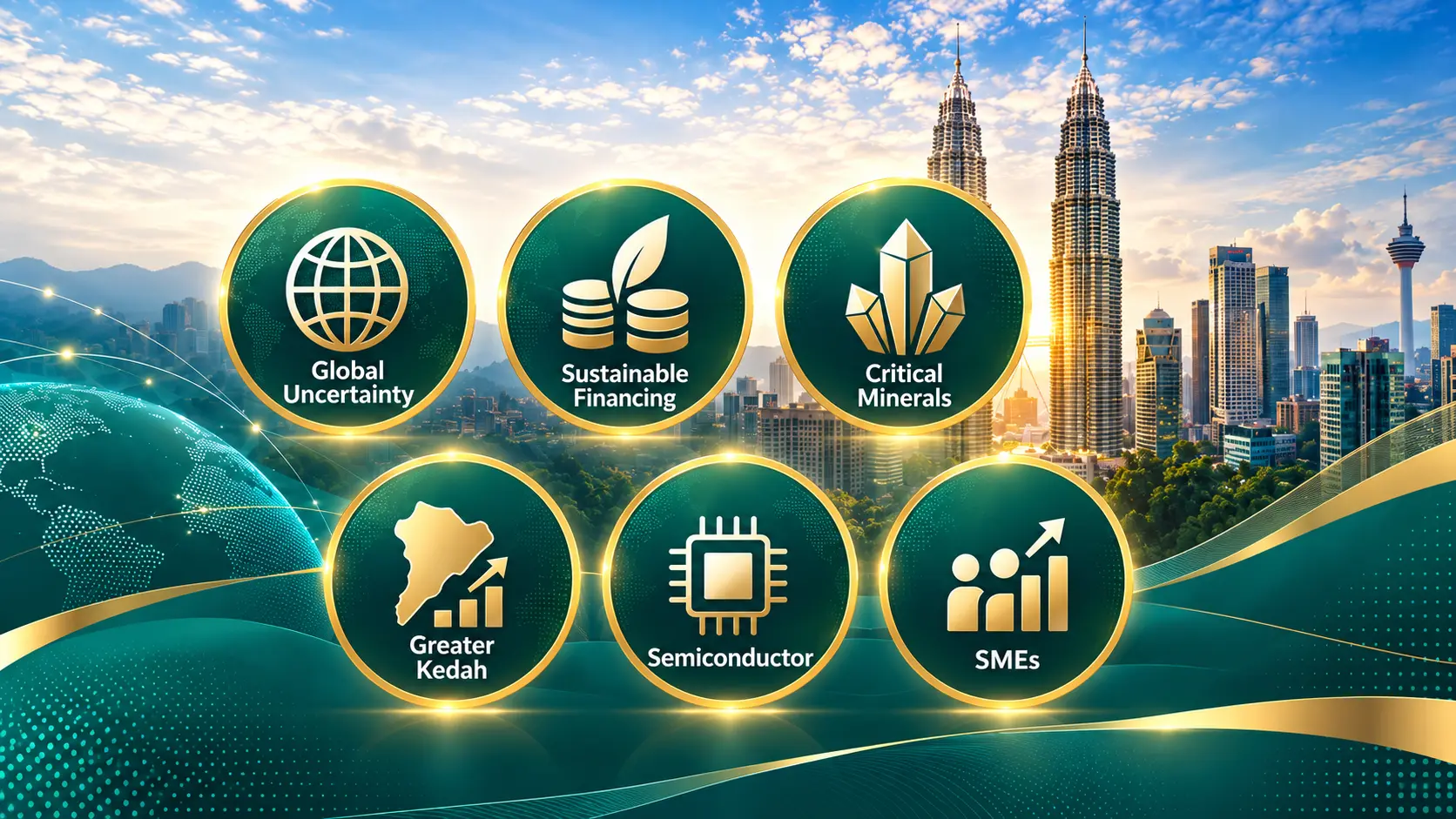
The SG4 Business & Economic Forum 2026 will bring several of Malaysia's most pressing economic questions into one programme on 26 October 2026 at the Kuala Lumpur Convention Centre.
Based on the official forum programme, the agenda moves from global economic uncertainty and sustainable financing to critical minerals, regional development, semiconductors and the challenges facing SMEs. Together, these discussions reflect a wider question for Kedah, Kelantan, Terengganu and Perlis: how can the four SG4 states turn their resources, industrial strengths and strategic locations into sustainable economic growth?
1. How Should Businesses Respond to Global Economic Uncertainty?
The first major issue is economic resilience in an uncertain global environment.
The programme opens with the address Managing Economic Development In a World Full of Uncertainties: Are We Ready?, followed by the first core session, A World Full of Uncertainties: Are There Still Hopes?
The discussion is framed around:
- global economic outlook;
- economic resilience;
- future growth prospects;
- national competitiveness.
This is relevant because companies and governments are making investment decisions amid changing trade conditions, geopolitical tension and external economic risks.
According to Bank Negara Malaysia's 2026 economic outlook, Malaysia is expected to remain resilient, with growth projected between 4% and 5% in 2026, although the global economy continues to face risks from tariffs, geopolitical conflict and weaker external growth.
For SG4, the question is therefore not simply whether economic uncertainty exists, but how the four states can continue attracting investment and developing new industries despite it.
2. How Can Sustainable Financing Support Future Growth?
The second major issue is access to sustainable financing.
Core Session 2, Managing & Offering Sustainable Financing in a Time of Chaos, brings together representatives from INCEIF University, Hong Leong Islamic Bank and Agrobank. The official agenda highlights Islamic finance, sustainable financing, capital accessibility and financial resilience.
Financing matters because many of the opportunities being discussed across SG4 — infrastructure, renewable energy, industrial development, agriculture and SMEs — require significant capital.
The issue is therefore broader than green financing alone. It includes questions such as:
- how businesses access capital;
- how projects remain bankable during volatile conditions;
- how Islamic finance can support development;
- how sustainability requirements affect financing decisions;
- how SMEs can secure funding for expansion.
This makes financing one of the practical links between economic ambition and actual project implementation.
3. Why Are Critical Minerals Becoming Strategically Important?
The third issue is critical minerals and Malaysia's position in global supply chains.
The programme includes a keynote address titled Critical Minerals: Positioning Malaysia in The Strategic Global Supply, delivered by the Chief Minister of Kelantan.
Critical minerals have become increasingly important because they are used across industries such as:
- electronics;
- advanced manufacturing;
- renewable energy;
- batteries;
- electric mobility;
- defence and high-technology applications.
For SG4, the discussion is particularly relevant because resource development can create opportunities beyond extraction.
The bigger economic question is how mineral resources can support downstream processing, value-added industries, technology and investment rather than remaining purely commodity-based.
That distinction matters because the long-term economic value of strategic minerals depends not only on what is extracted, but also on how much of the wider value chain can be developed domestically.
4. Can Greater Kedah Become a New Regional Growth Engine?
The fourth issue is regional economic development, represented by the keynote The Greater Kedah: Rising as Malaysia's New Economic Powerhouse.
The address is scheduled to be delivered by the Chief Minister of Kedah and places Kedah's future growth directly within the forum's economic agenda.
The Greater Kedah concept is relevant because Kedah already has several economic assets, including:
- Kulim's semiconductor and manufacturing ecosystem;
- industrial land;
- agriculture;
- infrastructure development;
- logistics connectivity;
- emerging energy investments.
The wider issue is whether these individual assets can be connected into a larger economic ecosystem.
Regional growth increasingly depends on the relationship between manufacturing, infrastructure, talent, energy and supply chains rather than on isolated projects.
For SG4, Greater Kedah can also serve as an example of how state-level economic development may contribute to a broader four-state growth strategy.
5. Where Are the Next Opportunities in the Semiconductor Ecosystem?
The fifth issue is the semiconductor industry.
Core Session 3 is titled Economic Opportunities In The Ecosystem of Semiconductor Industry and features representatives from Dagang NeXchange Berhad, ams OSRAM Group and Fuji Electric Malaysia. The programme identifies semiconductor ecosystem development, industrial policy, supply-chain opportunities and talent as key themes.
Malaysia already occupies an established position in the global semiconductor supply chain.
The National Semiconductor Strategy identifies Malaysia's existing end-to-end ecosystem, industrial infrastructure and talent base as important advantages, including major industrial locations such as Kulim.
For SG4, this creates several questions:
- Can more semiconductor activity be developed around Kedah?
- Which parts of the value chain offer the greatest opportunity?
- How can local suppliers participate?
- Is there enough skilled talent?
- What infrastructure is required to support higher-value activities?
This makes the semiconductor discussion relevant not only to large manufacturers but also to supporting industries, technology companies and local supply chains.
6. How Can SMEs Compete and Capture New SG4 Opportunities?
The sixth issue brings together SME resilience and the wider economic opportunities available across SG4.
Core Session 4, SMEs Survival Between Managing Challenges and Securing Opportunities, focuses on SME resilience, business transformation, manufacturing opportunities and access to international markets. It is followed by the Economic Opportunities in SG4 sharing session featuring representatives from Invest Kedah, Invest Terengganu, Invest Kelantan and Perbadanan Kemajuan Ekonomi Negeri Perlis.
This creates an important connection between two questions: how can SMEs remain competitive, and where are the next business and investment opportunities across the four states?
According to SME Corp. Malaysia, improving SME competitiveness requires businesses to strengthen capacity, productivity, innovation and access to international markets.
For businesses attending the forum, potential areas of interest may include:
- manufacturing;
- energy;
- agriculture;
- logistics;
- industrial services;
- technology;
- supply-chain opportunities;
- regional trade.
The SG4 sharing session then allows the four state investment agencies to present strategic projects, development priorities and investment opportunities within their respective states.

Why Do These Six Issues Matter Together?
These issues are not independent of one another.
Economic uncertainty affects investor confidence. Financing determines whether projects can move forward. Critical minerals and semiconductors connect Malaysia to strategic global industries. Regional development determines where those industries can grow, while SMEs form part of the supplier and business ecosystem needed to support them.
SG4 adds another dimension by bringing four states with different economic strengths into the same discussion across its strategic economic sectors.
The result is a programme that moves from broad macroeconomic questions to specific sectors and, finally, to practical state-level opportunities.
Conclusion
The six key economic issues at SG4 Business & Economic Forum 2026 reflect some of the biggest questions facing businesses, investors and policymakers today: how to grow during uncertainty, finance future development, capture strategic industries and create opportunities that reach businesses across different regions.
For SG4, these discussions also provide a framework for connecting the individual strengths of Kedah, Kelantan, Terengganu and Perlis with wider national and global economic trends.
Frequently Asked Questions
What are the key economic issues at SG4 Business & Economic Forum 2026?
The forum covers global economic uncertainty, sustainable financing, critical minerals, regional development, semiconductor opportunities, SME competitiveness and economic opportunities across SG4.
When is SG4 Business & Economic Forum 2026?
The forum will take place on 26 October 2026 at Kuala Lumpur Convention Centre.
How many working sessions are in the programme?
The official programme currently lists five working sessions, alongside keynote and special addresses covering additional economic themes such as critical minerals and Greater Kedah.
Will semiconductor opportunities be discussed?
Yes. A dedicated core session focuses on the semiconductor ecosystem, industrial policy, supply chains and talent development.
Are opportunities across all four SG4 states included?
Yes. The Economic Opportunities in SG4 sharing session includes representatives from the investment agencies of Kedah, Terengganu, Kelantan and Perlis.